A site the internal team can actually run.
A 40-page WordPress rebuild for CU*NorthWest -- audited, restructured around real buyer search behavior, rebuilt on Framer, and handed off to an internal team with no programming background.
The Situation
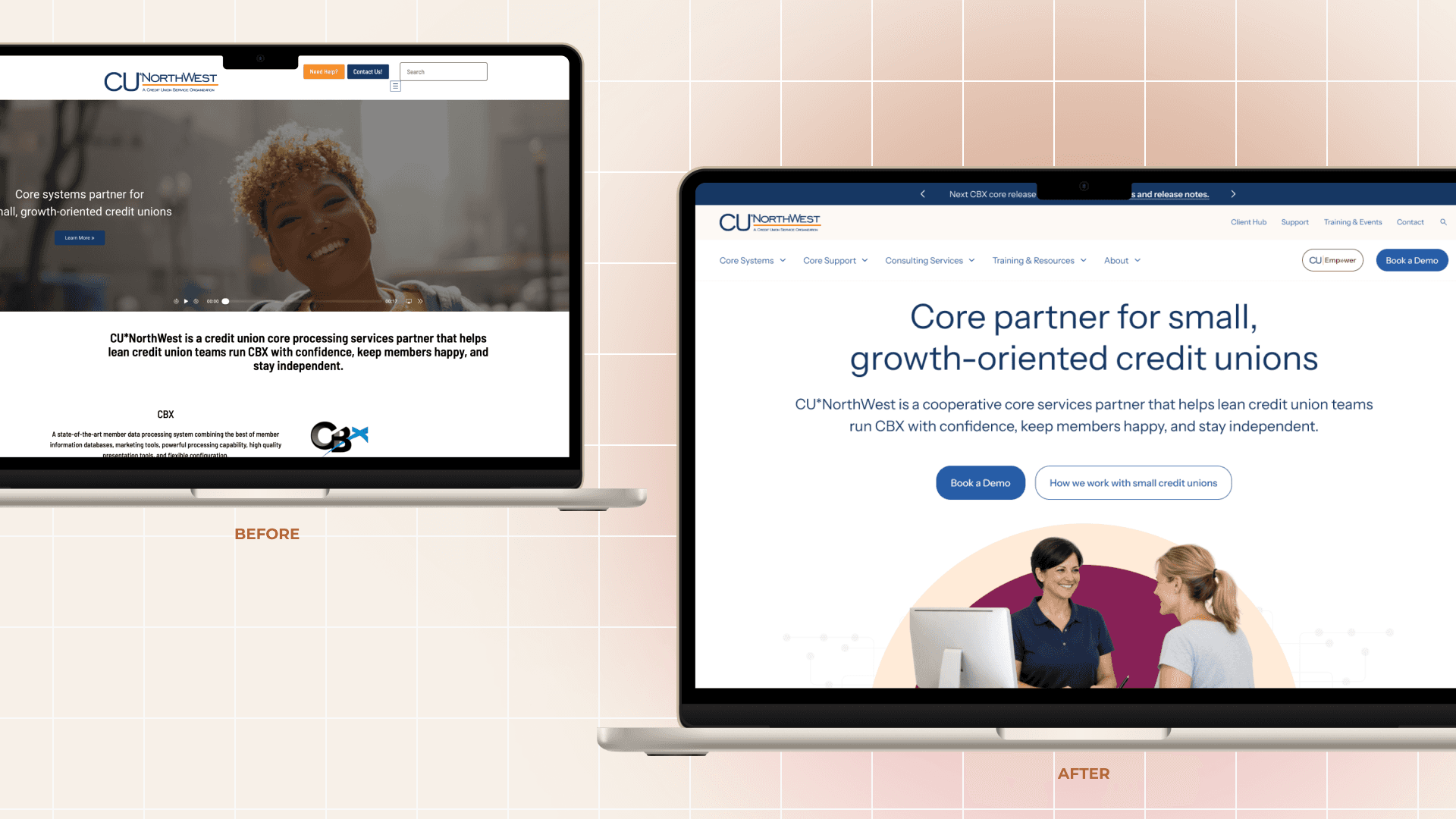
The most-visited page on CUNW’s old website wasn’t the homepage. It was the 404. That fact alone tells you most of what you need to know.
CUNW had inherited a WordPress site that had grown brittle over time. Adding a single word to a paragraph could take several minutes in the editor. The footer copyright still read “2023.” Fourteen pages were returning 400 errors and being served to real users.
The rebuild wasn’t in our original scope. It got added after a technical audit made the case impossible to ignore.
The site had grown to depend on a large, mismatched set of third-party plugins -- a common reason WordPress sites become unstable, insecure, and expensive to maintain over the years. Custom navigation work bypassed the standard WordPress editor, which meant renaming a navigation item required code changes through a developer. Content was hard-coded in places it shouldn’t have been. Test pages had been published and indexed by Google. Underneath all of it, the site was misaligned with the new brand foundation we were building in parallel. Updating it page by page would have taken longer than rebuilding it.
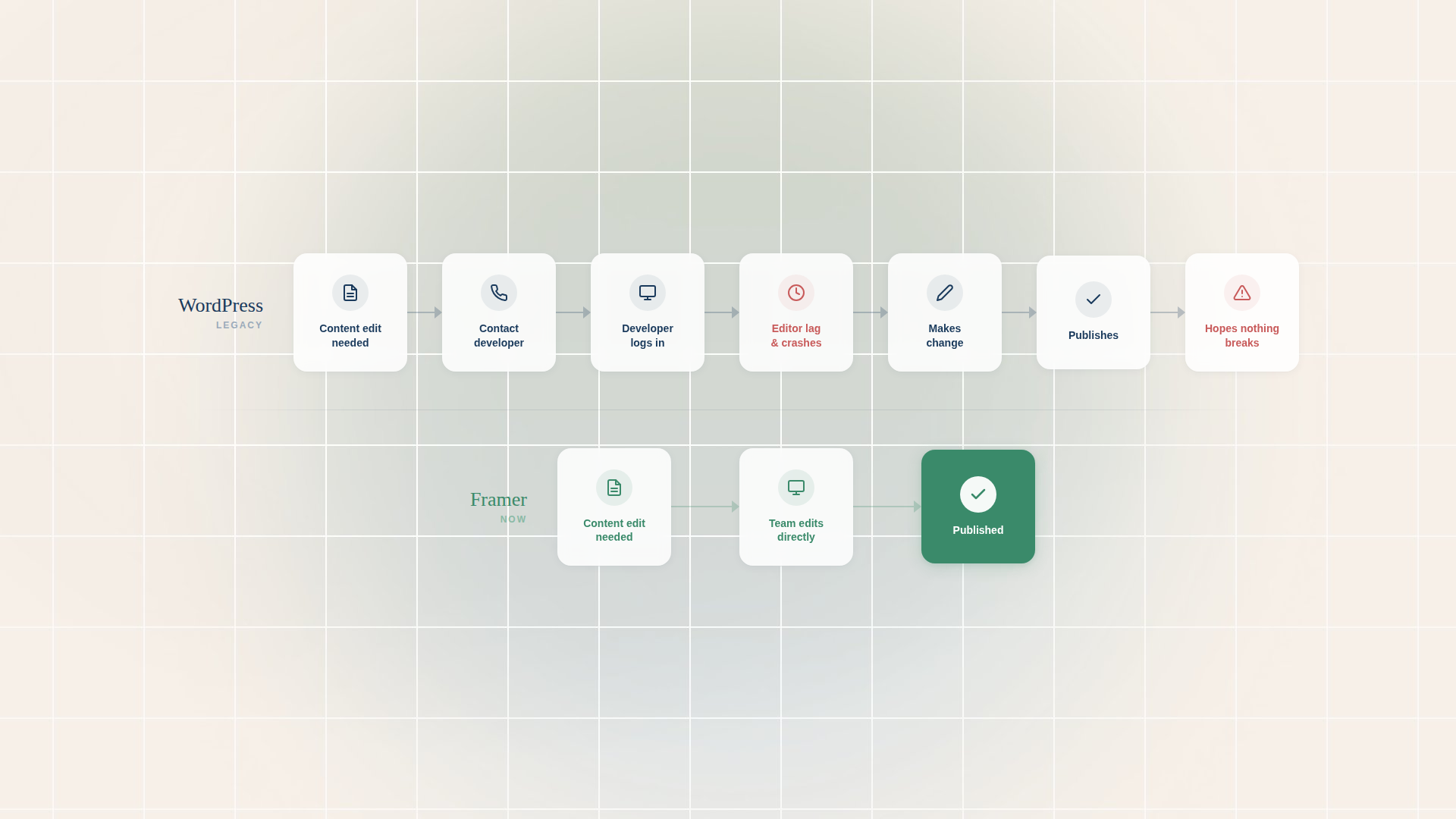
The math was straightforward. The site was simple -- about 40 pages, no transactional functionality. The leadership team was open to a rebuild. The internal marketing team had no programming background and was tired of routing every typo correction through a developer. Rebuilding on a modern platform would let them take direct ownership.
What we did
Worked the problem the way it needed to be worked -- one phase at a time, in order.
Audit first, recommend second
A deliberately exhaustive document covering technical stability, plugin architecture, content alignment, SEO health, security, and site speed. The audit was structured to be the kind of artifact you can hand to an executive sponsor who needs to defend a rebuild decision internally. Not a quick recommendation -- a defensible one.
A platform decision framed for the audience
We laid out the trade-offs for the leadership team with a clear breakdown: stay on WordPress with a redesign, move to Framer, or move to a more lightweight framework. Framer was selected for its visual editor and its low-overhead maintenance model. The internal team would own the account; the site could be maintained by anyone with Framer access; no specific developer would be required.
Custom keyword research, not generic SEO
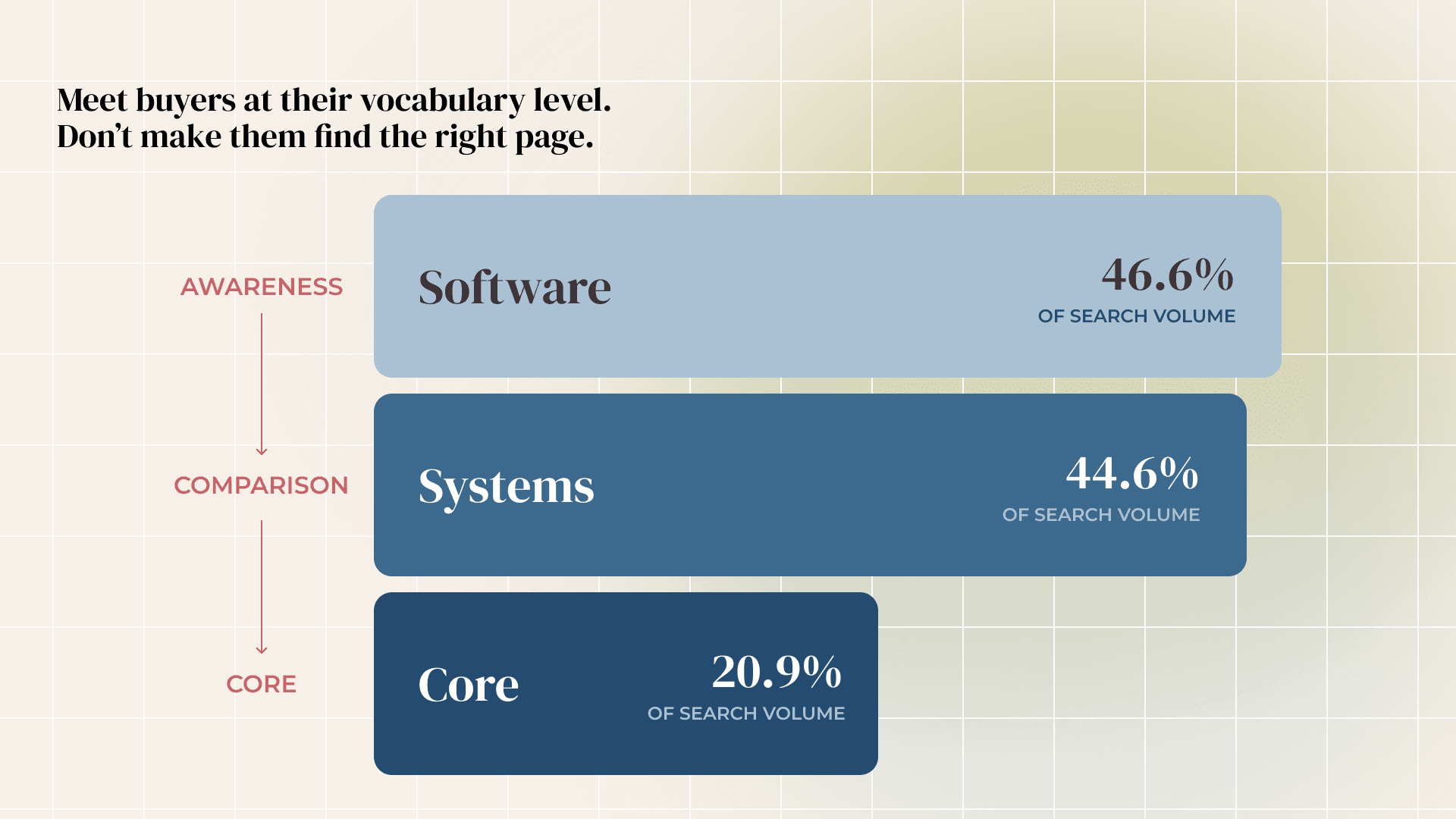
We ran a custom semantic analysis on 44 keywords pulled from real Google Ads data and cross-referenced against an initial AI-generated evaluation. Two findings drove the entire site architecture.
The vocabulary ladder. Searchers use three vocabulary tiers that map to where they are in the buying journey -- “software” (early stage, widest funnel), “systems” (mid-stage comparison), and “core” (late stage, educated). The homepage and top-level navigation use the broader vocabulary. Deeper pages use the late-stage terminology. Every page weaves synonyms from all three tiers in the first 100 words to win semantic search and AI overviews.
Feature-as-entry-point. About 20% of the keyword set was people searching for specific capabilities -- loan origination, account opening, compliance tools -- assuming they’d need a separate fintech to add to a core. CBX already includes those capabilities. The content strategy was rewritten to lead with “this is included” rather than treating these features as standalone categories. Highest-leverage content opportunity in the keyword set.
A design pattern library
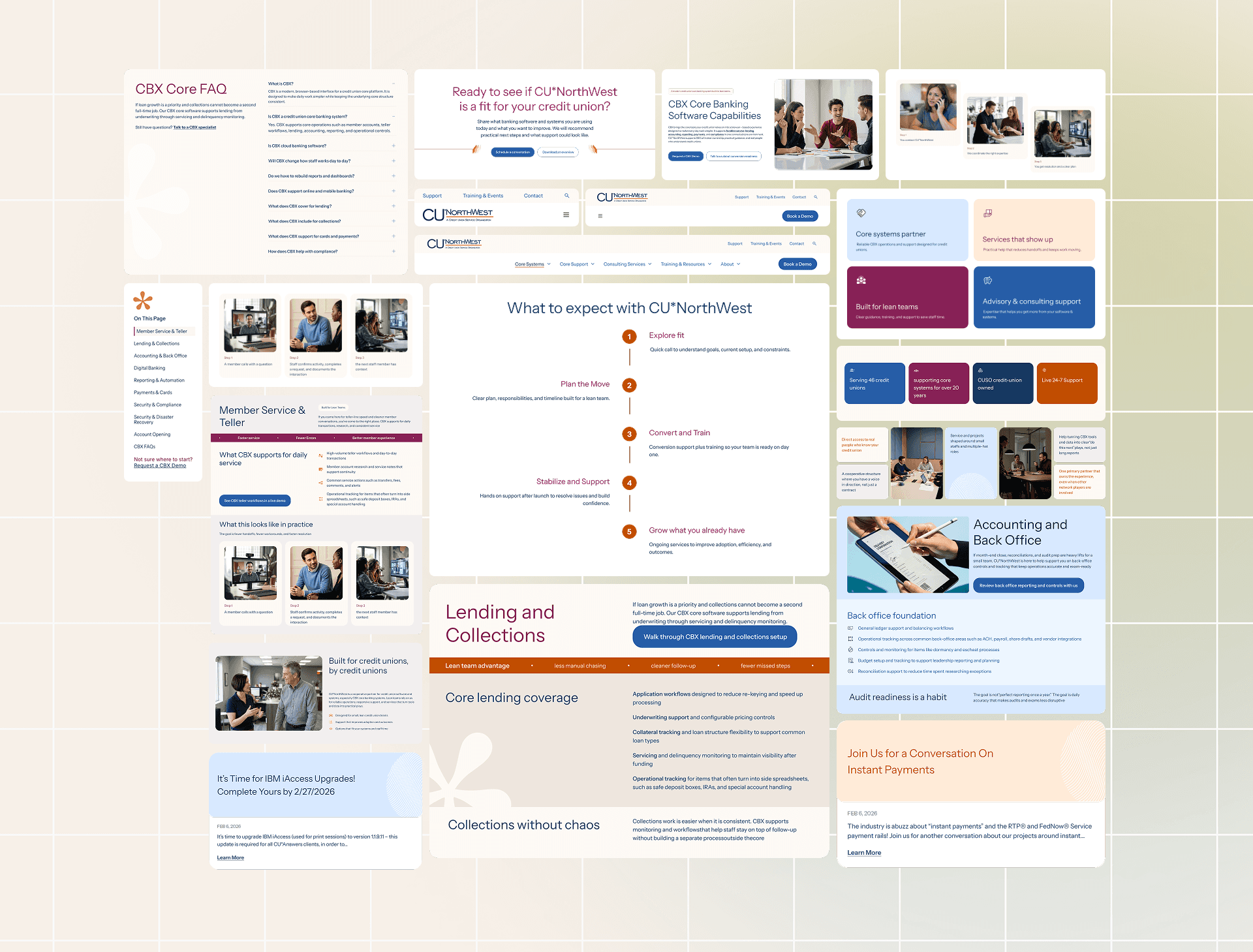
We worked with our developer partner Adi to extract a complete set of reusable blocks -- page heroes, content sections, FAQ accordions, CTA footers, stats bars, alternating text and image cards, step cards, numbered timelines, four-card grids -- and documented every one with content slots, content guidance, and “when to use” rules. Copy documents reference block names in brackets so the developer knows exactly which design element to build. The library is mix-and-match, which means future pages can be added without commissioning new design work.
Eleven pages of brand-aligned, keyword-targeted copy
Each page developed in a separate focused chat with the brand foundation, the keyword analysis, and the content guide attached as project knowledge. Every page passes a brand voice and content rule audit. Every page targets a primary keyword cluster with no cannibalization between pages. Page metadata, design block references, source citations, and an aspirational-vs-current-state framing are documented for each.
A coordinated DNS cutover
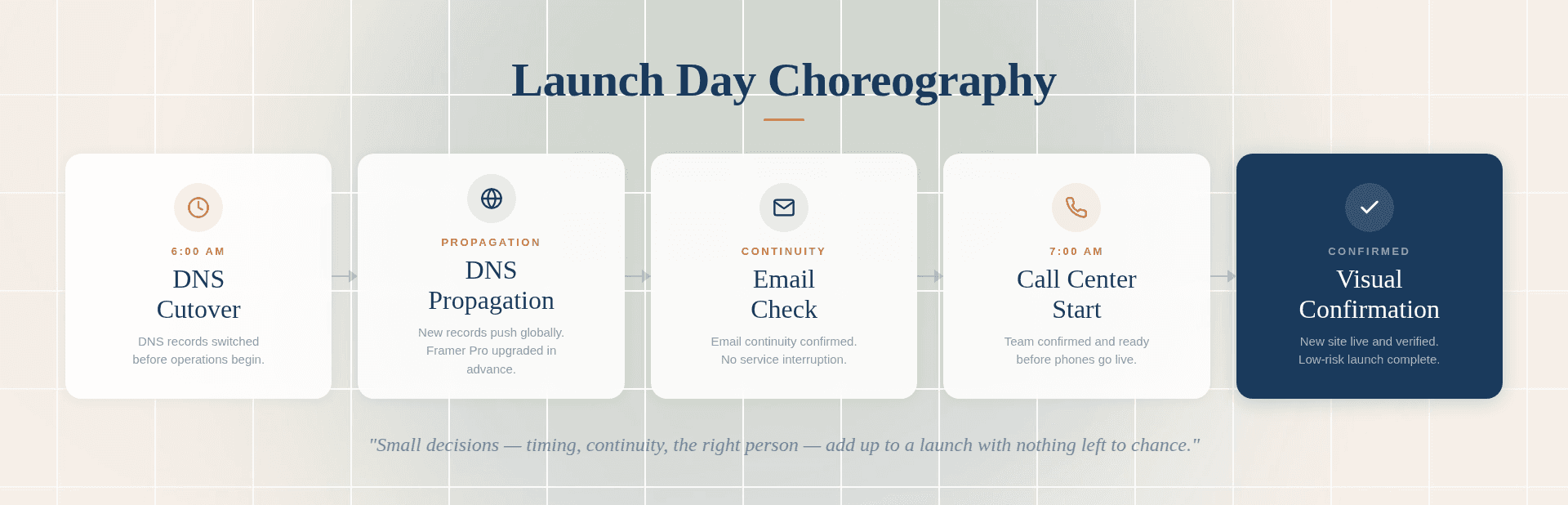
Scheduled for 6:00 AM Pacific time on a Thursday before normal operations started. Explicit DNS record changes pre-specified. Email continuity confirmed in advance. 301 redirects set up to preserve URL changes and SEO equity. The Framer account upgraded to Pro before cutover so the necessary records could be exposed.
“I’m fully on board with Framer. It just makes sense. Anybody could do it internally.”
—
Internal Marketing Lead, CU*NorthWest
The report card
The internal team owns the platform. They can update copy, swap images, and make routine edits without contacting a developer -- which removed a long-standing operational bottleneck where every typo correction required external developer time.
Every page is aligned to the brand foundation. Vocabulary ladder integration, contractions, four-word CTAs, naming conventions, partner brand restraint, and outcome-first framing are enforced across the site.
Information architecture matches how buyers actually search. Pages target distinct primary keywords with no cannibalization. Navigation labels and page hierarchy meet buyers at their vocabulary level rather than forcing them to find the right page.
The technical debt is gone. Plugin sprawl, hard-coded content, the custom navigation problem, the editor instability -- all resolved. And the 404 is no longer the most-visited page.
Built to scale. The pattern library can be combined and recombined. New pages can be drafted by anyone with the Content Guide without commissioning new design work.
How we worked
A few things made this engagement run.
Custom research over generic templates
The vocabulary ladder insight only existed because the analysis was built around 44 actual keywords from this client’s market. A generic SEO template would have missed it entirely.
Pattern libraries beat bespoke pages
Documenting a complete pattern library before writing copy at scale turned an awkward three-party coordination problem (writer, designer, developer in different time zones) into a documented handoff. Every party referenced the same source of truth.
Frame each conversation for its audience
The executive sponsor needed to understand the political risk and the operational benefit. The internal marketing lead needed to know she’d own the site. Each got the framing that mattered to them, which produced faster decisions than a one-size-fits-all explanation would have.
Plan the launch as carefully as the build
Small individual decisions -- the early-morning timing, explicit instructions in advance, the right person identified to execute the change, email continuity confirmed -- added up to a low-risk launch.
Class is in session.
If your website is holding your team back, let’s talk.
PROJECT CREDITS
ENGAGEMENT LEAD
Krystal Crowe
Extended team
Martha Schmidt
Development
TaktForm / Adi Sirohi (Framer)
Visual design
TaktForm / Vasundhara Sharma
Client team
Internal marketing lead, executive sponsor, and CU*NorthWest leadership
DURATION
Approximately four months from scope expansion to launch (early 2026)