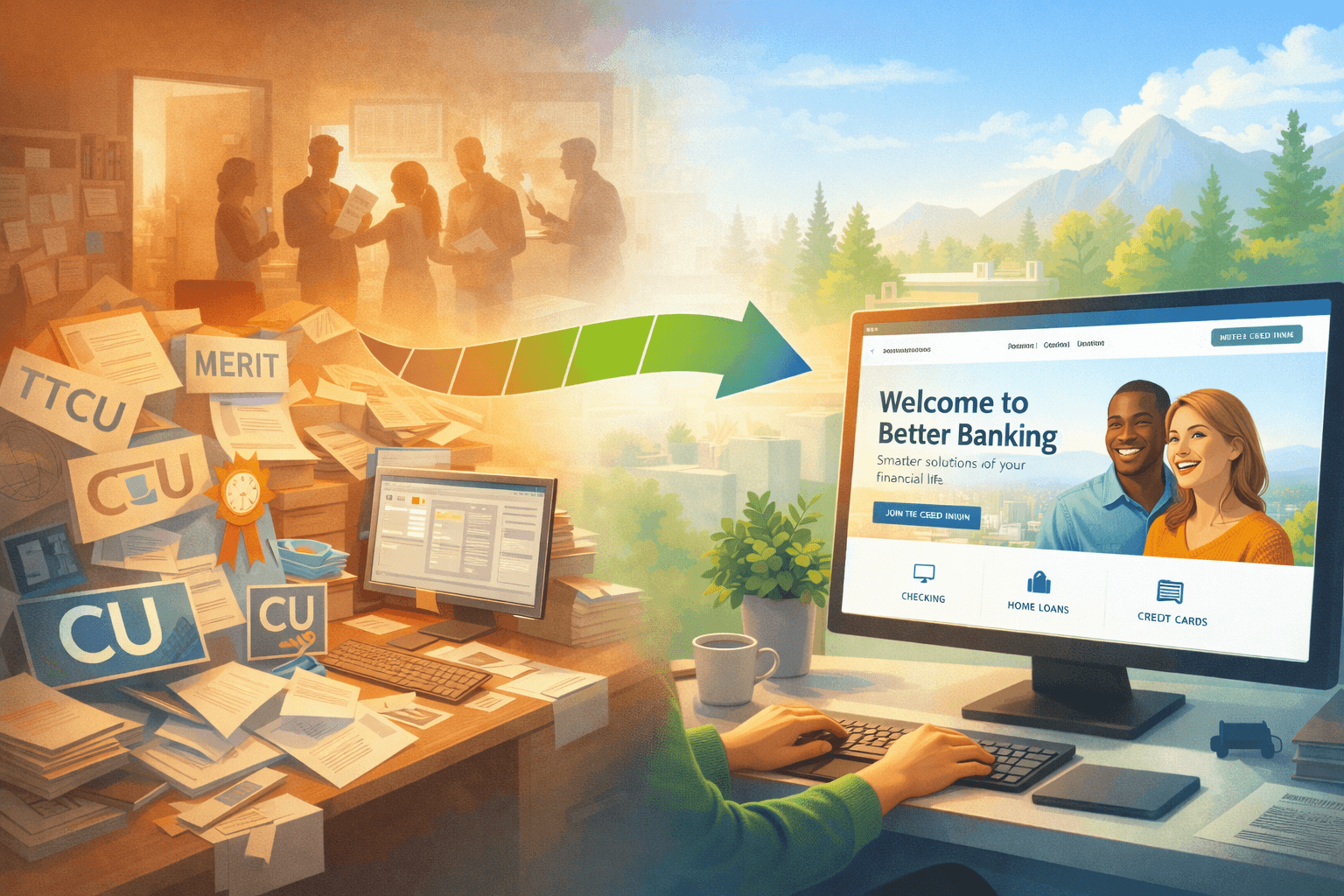
CU*NorthWest had strong relationships and real service strength, but its external story and website did not reflect it. Hickory Grove Consulting stepped in as a Fractional CMO to clarify positioning, align internal messaging, and rebuild the digital “front door” to better serve small, growth-oriented credit unions with lean teams.
The result: a clearer narrative, measurable KPIs, and a website strategy built to increase qualified inquiries without creating more internal lift.
Client snapshot
Client: CU*NorthWest (CUSO, cooperative core + services partner serving credit unions)
Business model: B2B, long sales cycles, high-trust buying process where referrals matter, but the website still needs to qualify and convert
Primary audience: Small, growth-oriented credit unions (often under $1B) with lean teams
The situation
The brand story lived in people’s heads
CU*NorthWest’s strongest differentiator was clear internally: service, access, and long-term partnership. The problem was that the story was not consistently documented, repeatable, or provable across teams.
People believed “service + support” was the biggest strength, but there were no shared proof points or standardized metrics to back it up.
Teams competed against much larger cores and network partners, but lacked a simple, consistent way to explain why CU*NorthWest wins.
Conversions and training were core to success, but there was no shared early-journey narrative that set expectations for prospects and stakeholders.
The website was not doing its job as a growth engine
The site functioned more like a client-facing resource hub than a prospect-ready path to action. The data made it hard to ignore:
Analytics and structure signaled major leakage and misalignment with prospect intent.
UX and content skewed “insider,” which is helpful for existing clients but confusing for new prospects.
Technical SEO issues reduced discoverability, which compounded the conversion problem.
The cooperative story was an asset, but also confusing
Cooperative ownership is a genuine strength, but externally, “who owns what” across the broader ecosystem was not clear. There was also a real risk of leading with cooperative identity in a way that felt legacy or old-fashioned instead of modern and outcome-driven.
A key strategic tension
The strongest fit was clearly small, growth-oriented credit unions with lean teams. At the same time, there was pressure to appeal to larger institutions as well. The brand and website needed to resolve that tension with clarity, not compromise into vague, “for everyone” messaging.
Objectives
Brand + digital modernization (Fractional CMO north star)
Success looked like operational clarity first, then better digital performance. Specifically:
Align objectives and KPIs at the leadership level, including decision rules and a reporting rhythm.
Establish messaging pillars and proof points so web, sales, and support tell one story.
Clarify the priority audience and map their buyer journey.
Improve go-to-market assets (website clarity and CTAs, sales deck, event materials) to lift qualified inquiries, especially in western states.
Turn on measurement basics (GA4 events) and create a lightweight cadence the team can sustain.
MaaS foundation improvements (parallel track)
Lay the groundwork for a plan-first, measurable MaaS offer with clear tiers, support levels, SLAs, ownership, and rollout approach.
Do it without disrupting existing clients.
Constraints that shaped the approach
This engagement had real-world guardrails, which is where strategy either gets practical or gets ignored.
The goal was not a full rebrand or a massive website redesign “because it’s time.”
Any external promise had to be deliverable by a lean team. No shiny claims that create internal panic later.
The website needed to be manageable by non-engineering staff to reduce bottlenecks.
Partner dynamics required careful ownership language: CU*NorthWest must “own the experience” without creating unnecessary friction.
Discovery + diagnosis
Stakeholder alignment + operating cadence
We started by setting a cadence and decision rhythm that matched the organization’s reality.
Approval process: CEO final approval on major external deliverables; day-to-day approvals handled by the primary contact.
Working cadence: consistent touchpoints to keep decisions from drifting into “we’ll circle back.”
Voice-of-customer + internal insight gathering
We ran interviews to capture what people believed was true, then pressure-tested it against what clients actually value.
Internal interviews surfaced differentiation themes and where confidence broke down.
External interviews validated the real retention drivers and the gaps.
Consistent “why clients stay” themes:
Direct access to real people and decision-makers
Strong fit for lean teams
Trust and long-term relationships
Cooperative/network advantage, when explained clearly
Key gaps we identified:
Clients wanted more help turning tools into outcomes, not just tools.
The website under-sold the real experience.
Ownership across the ecosystem was unclear externally.
Digital + analytics audit (baseline reality check)
We validated the site’s performance with the unglamorous stuff: behavior flows, leakage points, and how people actually moved (or did not move) toward contact intent.
GA4 behavior showed severe leakage, including the 404 page as a top destination.
Sitemap and technical SEO issues likely suppressed ranking and discoverability.
Embedded and partner-content sections were not seeing meaningful visitor volume.
Conclusion: the site was not aligned to a prospect journey (clarity → proof → action).
The strategy
Clarify positioning for the right buyer
We made a deliberate choice: lead with the best-fit audience, not geography.
Primary audience: small, growth-oriented credit unions with lean teams.
To keep messaging grounded, we built around two practical personas:
Jordan (exec operator): juggling risk, growth, and limited staff; wants fewer vendors and clear ownership.
Taylor (ops/IT builder): wants substance, roadmaps, and practical examples, not ticket ping-pong.
Build a proof-backed story (not “great service” claims)
In trust-based B2B, “we have great service” is table stakes. Proof is what moves the conversation forward.
Core decision: “We are a cooperative like you” is a proof point, not the headline.
Messaging pillars (example structure):
Cooperative core partner with aligned incentives
Reliable core + services that show up (access + accountability)
Built for small, lean teams (practical guidance, not theory)
Shared innovation with a single point of contact (CU*NorthWest owns outcomes)
Proof plan:
Formalize client quotes and approvals for publishable use
Identify 2–3 service metrics worth standardizing and sharing (response time, resolution, training milestones, etc.)
Create 2–3 short case stories that show what it is really like to work with CU*NorthWest
Make “what working with us looks like” visible
We built a simple early-journey narrative that prospects, boards, and internal teams could all understand:
Decision → conversion → training → confident daily use
This is where a lot of “trust friction” gets removed. People do not just want reassurance. They want a map.
Fix the digital front door so it can actually convert
We defined the site’s real job in plain language:
Increase qualified visibility (search, events, referrals)
Convert interest into demo and contact requests
Support existing clients without pulling prospects into documentation chaos
We also shaped governance and platform direction around one key truth: if every update requires engineering, the site becomes stale, and marketing stops learning.
AI and modern search consideration (without the hype): we structured messaging to make entities, outcomes, and proof points obvious. That supports both human scanning and AI-driven discovery surfaces where clarity and consistency matter more than clever copy.
Execution plan (what we changed and built, in order)
Phase 1: Immediate clarity + quick wins
Established baseline KPIs (traffic quality, top paths, conversion events)
Cleaned up high-friction navigation and content issues causing dead ends
Started a “proof pack” capture process: quotes, common objections, differentiators
Phase 2: Website direction + platform decision
Confirmed what the current CMS was enabling, and where it created bottlenecks
Identified technical and SEO issues blocking discoverability and conversion
Planned a move toward a CMS that supports non-technical ownership
Defined form strategy and tracking plan:
What happens when a visitor clicks “Request a demo,” “Talk to us,” and other CTAs
Ensure each CTA is measurable and routes to a clear internal owner
Phase 3: Brand foundation + messaging alignment
Produced a concise positioning + messaging guide:
Clear “who we serve” statement
Pillars and proof points
Ownership language across the partner ecosystem
“What we do / what we do not do” clarity
Translated messaging into core assets:
Homepage structure and hero direction
Key interior page direction (core systems, services, consulting, etc.)
Sales deck refresh
Event one-pager and field materials
Phase 4: Measurement + operating cadence
Implemented GA4 event tracking and a lightweight executive snapshot: traffic → high-intent actions → qualified conversations
Set a team-sustainable cadence: monthly KPI check-ins, learnings, and next best iteration
Kept decision-making grounded in data, not “strong opinions from the last conference attended.”
Brand & Marketing Deliverables
Positioning & Messaging Guide (pithy statement, pillars, proof points)
Persona + buyer journey summary
Website strategy package:
Information architecture and menu recommendations
CTA and form approach
Client Hub approach (helpful without creating support overhead)
Tracking plan (GA4 events; outbound resource link tracking)
CMS governance plan (who updates what; access rules; change control)
Priority web + sales assets:
Homepage copy and structure direction
Interior page direction
Sales deck updates
Event one-pager and field materials
Executive Snapshot & KPI Framework (what we measure monthly and why)
Optional parallel track: MaaS foundation work (tiers, SLAs, measurable plan-first operating model)
Early indicators:
Baseline metrics established and tracked consistently.
Key leakage causes identified and addressed (including dead-end behaviors) and a scalable CMS plan defined.
Go-forward strategy and operating model approved: who owns what, how changes get made, how success is measured.
What we will measure and why (built for long-cycle, regulated B2B):
Percent of sessions reaching high-intent pages (Services, Request a Demo, Contact)
Form starts and completions by offer area (core, conversions, IT, consulting)
Qualified conversations attributed to web and conferences
Organic traffic share and rankings for priority “small CU” intent keywords (tracked quarterly)
Reduction in 404 and other dead-end paths as a share of sessions
Key takeaways
Positioning is not a tagline. It is operational clarity.
If internal teams cannot explain who they are for and why they win, the website cannot fix it. It can only mirror the confusion.
“Great service” has to be measurable
Proof beats adjectives, especially in trust-based B2B. Publishing the right metrics is not about bragging. It is about reducing buyer risk.
Lean teams need lean systems
A lean team cannot run an “engineering-required” website forever. The best strategy in the world still dies if the operating system cannot support it.
In partner ecosystems, ownership language matters
You can highlight the network without outsourcing accountability in the prospect’s mind.
How this maps to Hickory Grove’s core solutions
This work blended three Hickory Grove solutions in the way they are meant to work together:
Strategic Consulting: leadership alignment, decision rules, KPI framework, messaging clarity
Strategic Consulting
Digital Growth: measurable CTAs, conversion paths, and a plan to grow qualified visibility through search and content structure
Web and Marketing Operations: GA4 events, governance, CMS direction, and a cadence the team can actually run
marketing operations